
158 years after British soldiers of the Kings Own Royal Regiment took a piece of hair and part of the shirt of Emperor Tewodros to Britain, Dr Robin Jackson, a retired British Colonel brought these relics back to Ethiopia after a handover ceremony organized by the King’s Own Royal Regiment Museum trustees in Lancaster on 12 May, followed by a further ceremony in Addis Ababa held at the Ethiopian Heritage Authority (EHA) on May 15.

With which pistol did Emperor Tewodros shoot himself?
In 1868, during the Magdala expedition to liberate the hostages taken by Emperor Tewodros, the British forces that stormed the Emperor’s mountaintop stronghold at Meqdela, found the Emperor dead, having committed suicide. The American journalist and explorerHenry Stanley claimed that the Emperor shot himself with the pistol sent to him by Queen Victoria which bears the inscription: “Sent to King Tewodros II of Abyssinia (1818-1868) by Queen Victoria, ‘in acknowledgement of the kindness shown by him to her servant Plowden’.” The revolver which was a gift from the Queen in recognition of the close relations between the Emperor and the British Consul is now in the Royal Collection. While this is an appealing story which has been oft repeated it is not corroborated from contemporary accounts.
Another pistol gifted by Napoleon III through his consul Guillaume Lejean, which was apparently smuggled out of Magdala before the British arrived and acquired by a Wello chief has also claimed to have been used by the Emperor to shoot himself. That pistol with a dedicated Amharic inscription King of Kings Tewodros of Ethiopia (with spelling mistakes in the Amharic visible in a photograph reproduced in an article about Magdala by the Italian explorer Anaratone), was handed over to Emperor Menelik by the defeated chief. It was later sent by the Italian explorer Antinori to King Umberto I but after reaching the Italian Geographical Society in Rome was not sent on to Turin. During the Italian Fascist period it was sent by the Society to be part of a colonial exhibition in Naples where it disappeared in the confusion of the war. While this story is also intriguing, Emperor Tewodros had numerous pistols, some of which were no doubt more ceremonial, and it is also interesting to note that in his final letter he mentions that he attempted to commit suicide and the pistol did not fire. He wrote to Napier: “But after I had written to you, when I cocked the hammer of my gun and put it into my mouth, though I pulled and pulled the trigger, it refused [to fire]. When people came running and tore it out of my mouth, it went off”.
The loot from Magdala
Some of the soldiers began to cut pieces of the Emperor’s hair and shirt as souvenirs, mementos ortrophies. Many artefacts were then looted and subsequently auctioned to provide a share of the proceeds to all the soldiers. These included royal regalia, personal possessions, clothing and jewellery of the Emperor and his wife, and items pillaged from the royal treasury and church including arcs of the covenant, crosses, censers, hundreds of manuscripts and armaments, including shields and swords. Many artefacts ended up in 27 museums and churches in the UK and nine other countries, and others in the personal collections of the soldiers, as detailed by Andrew Heavens in his book The Prince and the Plunder (2025) and his website, documenting the whereabouts of the loot.
The history of restitutions from Britain
Over the century and a half since then a number of items have been repatriated. The first, at the request of Emperor Yohannes in a letter to Queen Victoria just four years after the battle of Magdala, was the Kibre Negest, the manuscript of the Glory of the Kings, returned after the Queen approached the Trustees of the British Museum. The manuscript has been preserved for over a century and a half by the Ethiopian Orthodox Church and is still kept carefully in the Church of Raguel in Addis Ababa.

Two crowns were returned, one given to Empress Zewditu in 1925 after a visit by Crown Prince Ras Tafari and an audience with King George V in 1924, and forty years later another by Queen Elizabeth II, presented to Emperor Haile Selassie during her visit to Ethiopia in 1965.
In the early 2000s a number of artefacts were returned through the initiative of AFROMET, the Association for the Return of Magdala Ethiopian Treasures and are kept in the Museum of the Institute of Ethiopian Studies at Addis Ababa University.
Recent initiatives have included repatriations after cancellations of auctions following the intervention of the Ethiopian Heritage Authority with the support of the Scheherazade Foundation and the Royal Ethiopian Trust (RET) that have negotiated with sellers and arranged repatriations.
Emperor Tewodros and Prince Alemayehu’s hair
Coming to the recent cases of the Emperor’s hair in 2019 the National Army Museum trustees agreed to repatriate a lock of the Emperor’s hair after the then Minister of Culture Professor Hirut Woldemariam made a request during her visit to London in 2018 to which the trustees agreed on the grounds that human remains should not be kept and displayed. The Minister’s successor Dr Hirut Kassaw repatriated the hair in March 2019. The two strands of hair had been attached to a letter From Emperor Tewodros to Ras Bisewwir and other officials about unfettering the British Envoy Hormuzd Rassam. However, the hair was detached from the letter which was not repatriated on the grounds that it was not part of the human remains.
Another private initiative of voluntary repatriation of hair of Dejazmach Alemayehu, the son of Emperor Tewodros, took place in 2023 after Leonie Turner, a descendant of Captain Tristram Charles Speedy, who was the Prince’s guardian, brought the hair of Alemayehu aged 9 from New Zealand, which she found in an envelope that also had Captain Speedy’s hair. At the ceremony organized by the Scheherazade Foundation at the Athenaeum club in London on 21 September 2023, Leonie and her husband Tim decided that it would be fitting for Captain Speedy’s hair to travel back to Ethiopia along with that of Prince Alemayehu in a box with a postcard of the Prince. The hair was brought back to Ethiopia by Ethiopian Ambassador Teferi Meles on 6 th January 2024, along with a cup with “taken at Magdala” inscribed on a silver plaque, which was inherited and donated by John and Hanne Lea, as well as other items sourced by the Scheherazade Foundation from art dealers.
Repatriations after cancelled auctions
This was the second initiative of the Scheherazade Foundation, which in 2021 had enabled the repatriation of three cups, a hand cross and a psalter manuscript that came up for auction and belonged to Captain Arbuthnott. The auction was cancelled after the intervention of the Ethiopian Heritage Authority and the Foundation acquired the artefacts along with other items purchased from art dealers and presented to the Ethiopian Ambassador at a ceremony at the Athenaeum club in London on 8 September 2021.

The Royal Ethiopian Trust has played a key role in negotiating to acquire artifacts after the cancellation
of auctions. When a Magdala shield came up for auction in Newcastle in February 2024, the Ethiopian
Heritage Authority wrote to request the cancellation of the auction. After much media and press coverage as well a social media pressure and a statement by the All-Party Parliamentary Group of Afrikan Reparations the auctioneers eventually agreed to cancel the auction the day before it was to take place, and the shield was repatriated by the RET after it was displayed at the Toledo Museum of Art. Likewise, the auction of a hairpin belonging to Empress Tiruwork, the wife of Emperor Tewodros, came up for auction in Rome in May 2025. An appeal by the EHA led to the cancellation of the auction and the RET negotiated to acquire it. In March this year a handover ceremony was held in Washington at the Catholic University, prior to the shield’s repatriation.
The King’s Own Royal Regiment Museum repatriations of relics association with Emperor Tewodros
This latest initiative of repatriation of relics associated with the person of Emperor Tewodros seven years after the repatriation of the Emperor’s hair by the National Army Museum also includes part of the Emperor’s shirt with blood stains on it. At the initiative of the King’s Own Royal Regiment Museum (KORRM) Trustees the collection was studied by Eyob Derillo, a museum and library professional along with the KORRM curatorial team thanks to a Museum’s Association Communities and Collections Fund. He discovered the hair, and ascertained that the bloodstained piece of cloth, labeled as a handkerchief, was in fact part of the Emperor’s shirt. Unlike the hair returned from the National Army Museum this lock included a braid, providing the first concrete evidence of the Emperor wearing plaits, as depicted in later drawings and paintings.
The KORRM trustees approached the Ethiopian Heritage Authority (EHA) which enthusiastically engaged in discussions and requested a provenance assessment. The report, which studied the letters, diaries and regiment gazette concluded that the items were taken by officers of the King’s Own (then the 4th Regiment of Foot). The hair was taken by Ensign Edward Woodgate and the cloth by Ensign Charles Frederick Hooper. Fortunately, the cloth was given to the Museum by the Hooper family in 1931 and the hair by the Woodgate family in 2005. The repatriation was agreed in November 2025 with two consecutive linked handover ceremonies planned one in Lancaster and the second in Addis Ababa. The EHA invited a trustee of the KORRM to come to Ethiopia for the second handover ceremony.
The handover ceremony in Lancaster
The Director General of the Ethiopian Heritage Authority, Assistant Professor Abebaw Ayalew was unable to travel to the UK and I had the privilege and honour of representing the EHA as a member of the Ethiopian National Heritage Restitution Committee. After a visit to the newly completed impressive display of Ethiopian artifacts at the KORR Museum, the ceremony took place at the University of Cumbria’s Saint Martin’s Chapel. Invited guests included dignitaries from the Lancaster City Council and the Universities of Lancaster and Cumbria, representatives of the Ethiopian Embassy, the Ethiopian Orthodox Church and community and the Royal Ethiopian Trust, as well as members of the press. The main guests of honour were Lord Robert Napier, the great great grandson of Field Marshal Robert Napier who led the Madgala expedition and was elevated to the peerage as Baron Napier of Magdala, who came with his sister Ruth Self.
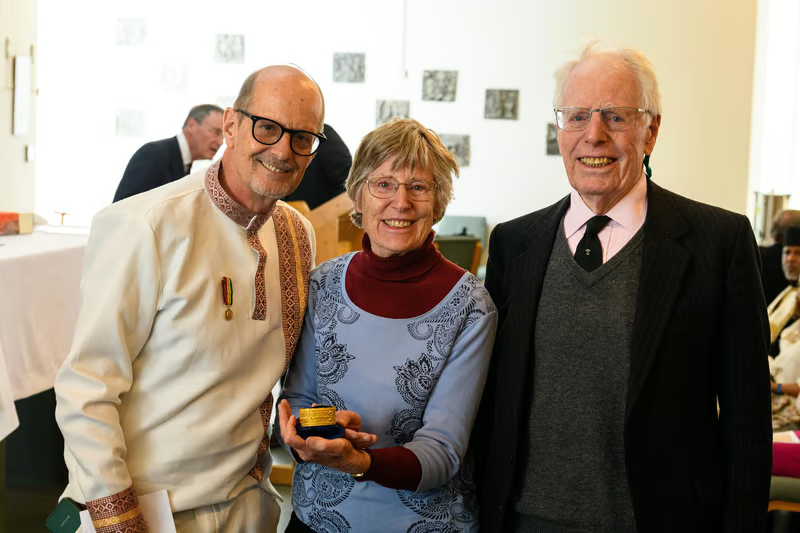
The ceremony began with a welcoming address by the Chaplain, Reverend Claire Shepherd, followed by an introduction and history of the King’s Own Regiment and its role in the 1868 Magdala expedition by Retired Colonel Dr Robin Jackson, chairman of the KORRM trustees. The research project was introduced by Eyob Derillo and Carolyn Dalton, the Museum Development Manager.

A video message by the EHA Director General about the background to the Magdala expedition and expressing the gratitude of the EHA, on behalf of the People of Ethiopia was shown,. This was followed by a blessing of the relics by Father Abate Gobena, representing the Ethiopian Orthodox Church. Finally the relics were handed over by Dr Robin Jacskon on behalf of the Trustees to Dr Alula Pankhurst on behalf the EHA.

An additional gift was a highlight of the ceremony. Lord Robert Napier donated a beautiful filigree-gold necklace, which was given by Emperor Tewodros to Frau Pauline Flad, Germany’s first women pharmacist and roommate of Florence Nightingale, who married Johannes Martin Flad a Protestant missionary who came to Ethiopian in 1855. They got married in Jerusalem and raised 8 children in Ethiopia, three of whom were adopted. Along with other detainees the Flads were imprisoned when relations soured with Emperor Tewodros; they were released by the Emperor shortly before the storming of Magdala by Lieutenant-General Napier’s forces. It can be surmised that Mrs Flad may well have sold the bracelet since the prisoners were in need of funds to finance their return to their homeland. Finally, a speech was read on behalf of Prince Ermias Sahle Selassie by Nicholas Melillo, the representative of the Royal Ethiopian Trust, who has been instrumental in the repatriation after the cancellation of auctions of Empress Tiruwork’s hairpin in March this year with a handover ceremony in Washington at the Catholic University, and a Magdala shield in October 2024, repatriated by the RET after it was displayed at the Toledo Museum of Art.
The handover ceremony in Addis Ababa
The relics linked to the person of Emperor Tewodros were carefully packed by Rachel Roberts, the Collection Registrar, and with the bracelet were brought to Addis Ababa by Dr Jackson. A handover ceremony was held at the Ethiopian Heritage Authority on May 15 in the presence of representatives of the EHT, the Ethiopian Patriots Association, the Federal Army, notably Major General Tiruye Assefe, Director of the Heritage Studies Directorate, the Ethiopian Heritage Trust and the media.

The relics and bracelet were displayed and speeches were made by the EHA Director General, Retired Colonel Jackson, Dr Tsedeke Abate, the President of the Ethiopian Heritage Trust Board, and Dr Ayale Anawte, Deputy Head of the Amhara Regional State Culture and Tourism Bureau, and from the Patriots Association Tigist, daughter of a Patriot. After a celebratory bread cutting and coffee ceremony, certificates for Col. (Retrd) Jackson, the King’s Own Royal Regiment Museum, Ato Eyob Derillo and Lord Robert Napier were handed over by the EHA Director General to Dr Jackson, followed by a group photo session. Dr Jackson was taken to visit museums in the capital including the Adwa Museum, the Palace Museum, the Unity Park Grand Palace Museum, the National Museum and the Institute of Ethiopian Studies Ethnographic Museum.
The significance of these exemplary repatriations
These relics are of deep significance for the history and culture of Ethiopia and will be treated with the utmost respect they deserve and will be preserved carefully by the EHA. The bracelet will be displayed in the forthcoming National Museum exhibition within a section dedicated to the Magdala expedition in the central atrium on the Museum’s ground floor.
It can be hoped that these noble and generous initiatives of the KORRM trustees and Lord Napier will be the beginning of an ongoing relationship between the Museum and the Priory Church in Lancaster and the EHA and National Museum in Addis Ababa, and may inspire other museums and descendants of soldiers to follow suit.


Excellent article with historical details. Although a bit long , i thoroughly enjoyed reading the article. Thank you to all the individuals and institutions who relentlessly worked in many of the projects that made the return of Ethiopian historic items possible, including Professor Alula Pankhurst. Once these relics are placed in different museums, more treasures will start percolating from
different sources by generous people who find no use in hoarding and feel the treasures are more useful placed in places where the academician and the public can see and rejoice. Thank you once again.