
In 2002, Birtukan Mideksa presided over the high-profile case of dissident former defence minister Siye Abraha, who was accused of corruption after falling out with Prime Minister Meles Zenawi. The trial drew close attention because of the stature of the accused, but for Ethiopians accustomed to seeing judges carry out the wishes of those in power, there was little expectation of judicial independence.
To the surprise of many, Birtukan granted Siye bail, doing so in accordance with the law. Yet minutes later, as he stepped out of the courtroom, security officials moved in and rearrested Siye, rendering her ruling meaningless in full public view.
This prompted chilling threats, laying bare the peril of judicial independence in an authoritarian system. Birtukan received a phone call from an anonymous caller, a voice rattling off insults like a machine, its message delivered without hesitation or restraint: “Because you cooperated with a corrupt man, we will crush you in a car and spill your blood.”
Recalling the moment in her recently published Amharic memoir “Memeles” (The Return), she writes: “I lay pinned to the sofa, unable to move, as anger, fear, and confusion surged through my mind.” The threat lingered in the room long after the line went dead—heavy and inescapable—marking the moment when the cost of judicial independence became terrifyingly clear.
Bertukan’s childhood friend and neighbour, who found her in that state, wanted to know what had happened. She told her everything. Her friend insisted that she spend the night there, and for the next few days, Birtukan slept at her house. “When I asked her, “If they are determined to kill me, do you think this would spare me?” she replied, “Even if they try to kill you, let them pass by my side of the bed before coming to yours.” I did not mean that she was unafraid—I was frightened too. She did not give a hoot about the former defence minister; her only concern was to protect me,” Birtukan writes.
Birtukan is best known as the first woman to lead a major political party in Ethiopia. Readers will gain a detailed look at her early years and the judicial and political apprenticeship that prepared her for this high-profile role. The book offers a glimpse into Birtukan’s disciplined yet joyful childhood, where the roots of her faith, compassion, and resolve were first established. It also captures the anxieties, fears, and occasionally despair, as she found herself in conflict with the government in her efforts to uphold judicial independence—tensions that ultimately led to her resignation and, later, to her two imprisonments as an opposition party leader.
The title of the book, Memeles, evokes a sense of return—to her childhood, to the streets, homes, and faces she once knew. It tells her personal understanding of growing up during the repressive Derg era in Ferensay Legation, on the northeastern outskirts of Addis Ababa, where she was born in 1974 at the dawn of the Ethiopian Revolution. It traces her childhood and adolescence marked by a profound sense of solidarity with neighbors and her community, who affectionately called her “Mimi.” We watch her find her voice, learn to articulate her thoughts and feelings, and reckon with the realities of loving—and sometimes losing—the places and people intertwined with her identity. As historian Shimeles Bonsa notes in the introduction of the book, by focusing on the lower classes of society, Birtukan has succeeded in preserving stories that would otherwise remain marginalized or unheard. “In doing so, she recovers what we are in danger of losing: the untold and unstudied foundational layers of our humanity, the country’s social history, and the social threads that connect communities across time,” he wrote.

At the heart of the book is the story of her mother, who was from the Dera district of North Shewa in Oromia and served as the primary caretaker of the household. To support the family, she traveled by train to Dire Dawa to buy secondhand clothes, shoes, and perfumes, which she resold in Addis Ababa during a period of scarcity. Such journeys were risky, as goods could be inspected and confiscated at any time.
On one occasion, she brought her daughter along with her.
After Birtukan became involved in politics and was arrested on charges of “conspiracy against the Constitution,” her mother assumed care of Birtukan’s infant daughter—a responsibility that weighed heavily on the elderly woman, who struggled with age, grief, the sudden burden of guardianship, and the task of bringing food to the prison. Her death, two years after Birtukan’s return from the United States, haunts this book, and the force of her unforgettable personality resonates throughout.
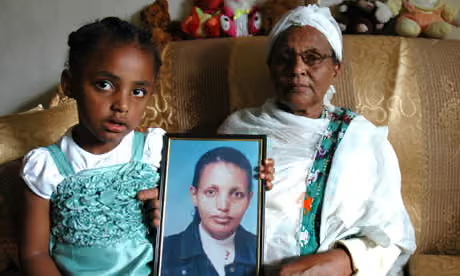
Birtukan also writes with great affection for her father—a former member of the Kibur Zebegna (the imperial bodyguards)—who was already a pensioner at the time of her birth. After the 1974 Revolution, he was called back to service, took up arms, and served in a paramilitary militia responsible for maintaining security in the area. She recalls him returning from night duty with biscuits and cookies, small gestures that became cherished memories of her childhood.
The author highlights the women and men in her neighborhood, extended family, and community who contributed in various ways to her education and that of other children. One such person was Eteye Boge, who came to her rescue when she got lost. As she recounted it, when Birtukan was five years old, her mother took her to the church school for her first day, early in the morning. They walked for about ten minutes, weaving through narrow side streets. At midday, however, her mother did not return to pick her up. Left on her own, Birtukan tried to walk home. She recognized the general direction, but the familiar route had disappeared. In front of her stood a house with an iron-sheet fence blocking the path she knew. Confused and frightened, she began to cry. Lost on her way home, she was eventually found by Eteye Boge, who asked what had happened. “The road that goes to my home is now closed,” she told her. Gently, Eteye Boge lifted her onto her back and carried her safely home.
Such moments of neglect and oversight aside, the family remains central in her honest yet tender account of growing into an emotionally and intellectually mature woman.
After high school, Birtucan pursued law at Addis Ababa University, although her first choice had been medicine. A C grade in mathematics prevented her from following that path, despite her strong overall academic record. After graduating, she applied to the federal courts, first working as a clerk before being appointed as a judge at the First Instance Court.
At the age of twenty-six, she impulsively decided to run for parliament as an independent candidate, sparked by a newspaper report about a parliamentary dispute she was reading at a café. The illegal government practices she had observed firsthand in court further galvanized her decision to step into politics, as she later reflected. However, many around her discouraged the idea, questioning the integrity of the country’s democratic processes. During this period, she also faced a disturbing threat from a so-called journalist who demanded sexual favors, threatening to publish a smear piece, falsely portraying her as a government-backed decoy and a tool of the regime. Despite the threat, she did not go to the police or pursue formal legal action, despite her legal training. Instead, she confided in an acquaintance—a former radio journalist who happened to know the man involved. Through this informal intervention, the situation was resolved. All the same, she says that running as an independent was a formative experience, marked by friends and neighbors stepping in to help and support her throughout the campaign. Even though she didn’t secure a seat, the experience strengthened her ties to the community and deepened her understanding of grassroots politics.
In her memoir, Birtukan’s political trajectory unfolds with quiet inevitability, in 2005, when she co-founded the Coalition for Unity and Democracy (CUD), a coalition crafted to challenge the dominance of the Ethiopian People’s Revolutionary Democratic Front in the 2005 elections. Her engagement in politics brought swift retribution—repression, vote-rigging, and repeated arrests. Yet, at the time, she emerged as a figure of profound moral clarity—a heroine, perhaps, in the public eye, her plight resonating deeply, especially as a single mother separated from her daughter.
Then came the years of exile, a seven-year stretch in the United States, studying at Harvard, before she ultimately returned to Ethiopia, in November 2018 brought her full circle—appointed to lead the nation’s election board.
This is a heartwarming memoir of a woman who became a symbol of liberation, shaped by the churn of prolonged surveillance, harassment, and exile. What emerges is a nostalgic yet unflinchingly measured portrait, written with remarkable assurance, tempered by a lightness of touch even when confronting difficult material. The narrative’s fragmentary structure can, at times, be disorienting: it zigzags from subject to subject, keeping the reader alert, never quite certain where the next turn will lead.


Good review for those unable to read in Amharic. Thanks.