The case of Hana Wondimagne
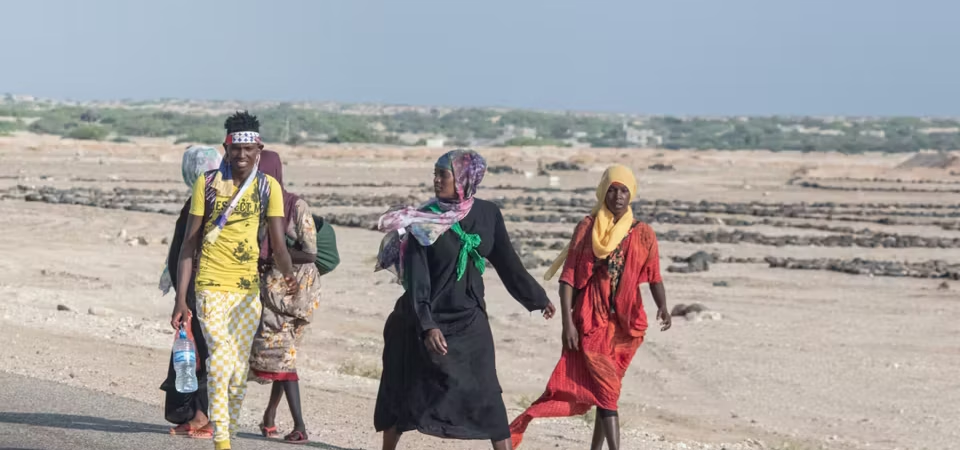
Hana Wondimagne, originally from Kobo town in the Semien Wollo Zone of the Amhara Region, had lived in Jeddah, Saudi Arabia, for several years. She sold traditional clothes online, mostly to Ethiopians living there, and often modeled them herself, gaining a modest following on TikTok. Lacking legal status, she decided to return to Ethiopia to regularize her situation and reunite with her child, who remained in the country, taking an irregular route via Yemen. She was transported by human traffickers operating along the Saudi Arabia–Yemen border.
What happened after she arrived at the Yemen border remains a matter of dispute. According to the traffickers, Hana died from exhaustion and physical weakness during the journey after sexually molested by a bandit who stopped her on the road and separated her from the rest of her group. However, another girl and two others who had been abducted with her claimed that Hana was still alive and being held by traffickers, who were exploiting her as a sexual slave. Her father said the trafficker contacted him to report her death. He demanded proof—either a photo or video—but was told the burial site could not be opened because it “smelled bad.”
The uncertainty surrounding Hana’s fate has drawn widespread attention, with many claiming to have inside information and offering conflicting accounts. Some TikTok users launched a campaign to secure her release, convinced she was still alive. They contacted and interviewed family members, as well as suspected traffickers online and by phone. One influencer, Abu Fano, who has 656.4 thousand followers, invited Hana’s husband, Abeb, to speak. The husband explained that, in an attempt to return to Ethiopia, he and Hana contacted a friend, Getahun, who put them in touch with a trafficker, Getachew (known as Yimetch), based in Jeddah. Hana then joined a group traveling along the route and was driven to Sabya.
“The last time I spoke to her, she was in Sabya. The following evening, they were due to be transported by vehicle to the Yemen border,” her husband said. She continued the journey on foot with a group that included Shumye Eshetu, known on TikTok as “Yegeter Lij” (“country boy”), who was also trying to return to Ethiopia. The group was being moved toward Jazan province, navigating harsh terrain under severe conditions.
In an interview with another influencer, Habu, who has more than 825,000 followers, Getachew (Yimetch) described a phone call he received from Hana during the journey. According to him, she said she was exhausted and asked for a donkey to carry her. He said he told her to keep going through the difficult terrain, assuring her that help would be arranged once she reached flatter ground. Another witness traveling with the group said they had not eaten for the previous twenty-four hours.
From there, she was reportedly handed over to another trafficker who would lead her to Teklay, who operates in Yemen with his brother. At another point, Getachew claimed that Teklay called him and made him listen as Hana cried intensely in the background. He attributed her distress to illness or what he described as a “bad spirit.” However, others traveling with her recounted a more troubling version of events. They said Hana was deliberately held back and pulled away from the group by two members of the trafficking network. When one person protested and urged them to let her go, he was reportedly struck.
These diverging testimonies underscore the opacity and brutality of the trafficking routes along the Saudi–Yemeni corridor, where migrants often disappear without clear answers. A camp with red tents—where many women are reportedly detained and exploited as domestic workers and sexual slaves—is being circulated widely online, with claims that it is located along the border. In Hana’s case, the absence of verifiable evidence—combined with contradictory witness accounts—has left her family and a growing online community searching for the truth, caught between claims of her death and the possibility that she may still be alive.
One striking element in this account is that many of the traffickers operating along this route are themselves Ethiopian. One of the principal figures, Getachew (known as Yimetch), is said to operate from Jeddah, where he reportedly recruits women from the Shewa Robit area—his place of origin—while also owning several buildings in his hometown. He works with three brothers—Teklay Aregawi, Tsegay Aregawi, and Zeray Aregawi—are identified as key figures in the network, reportedly coordinating movements and controlling different stages of the journey. One of the brothers, Zeray Aregawi, is said to be based in Addis Ababa, where he recruits young women, particularly from Shewa Robit, Harbu, Dessie, Kombolcha and parts of the Amhara region. Teklay, meanwhile, is described as the key figure along the Yemen border, where he is believed to maintain close ties with the armed group controlling the area.

At the same time, young people from the Amhara region attempting irregular migration to Saudi Arabia via Yemen and those are attempting the journey in reverse are frequently losing their lives along the way, highlighting the extreme dangers of the route. Many undertake the journey in search of better economic opportunities, but the trip—often organized by traffickers—exposes them to violence, exploitation, harsh conditions, and severe deprivation, with little access to food or water. In Yemen, a country gripped by civil war, these risks are even greater: migrants are sometimes kidnapped by gangs, and women are particularly vulnerable to sexual exploitation. Despite these risks, migrants reportedly pay between 300,000 and 500,000 Ethiopian birr, often without any guarantee of safety.
Rahmit Ali, her cousin who had travelled with her, was killed in front of her in a border town between Yemen and Jizan.“They came and seized him. They put a piece of cloth over his eyes and shot him. He collapsed. It was not possible to retrieve his body. I could not cry—if I cried, if I said he was my family member, they would have attacked me too, he would been eaten by vultures.” she told DW Amharic.
Many young people from South and North Wollo make this journey regularly. Wasihun Mitiku, a resident of Raya Kobo Woreda, says, “Every day, we are struck by grief over the deaths of our young people; sadness keeps weighing on us.”
“So many are leaving the Raya area, and every two or three days we receive calls with the sad news: ‘This person has died, that person has died.’ Many are dying, and many are forced to leave their homeland because of the desperate conditions here.”
The Eastern route is one of the world’s most dangerous, according to the International Organization of Migration (IOM), which documented at least 922 deaths in 2025. Almost all of those who died on this route in 2025 were Ethiopian, many of whom lost their lives in three mass shipwrecks that claimed more than 180 lives each. Boats carrying migrants are often dangerously overcrowded and poorly equipped, putting passengers at constant risk of capsizing or drowning. Even those who reach land face new threats: with few resources, migrants become easy targets for traffickers, armed groups, and kidnappers, who exploit their desperation for profit or political leverage.
Awel Ahmed, a young man from Kombolcha, and Tesfaye Sisay, a resident of the Key Gara area in Raya Kobo, have repeatedly traveled to Saudi Arabia through illegal routes. They say that a single journey can cost starting from 300,000 Ethiopian birr.
“Some people go for free, while others pay between 400,000 and 500,000 birr in Ethiopia. From here to the border, it costs about 95,000 birr. Then, to cross the border, you pay another 45,000 birr. After crossing, there is someone who arranges transportation for you. For example, my uncle paid around 300,000 birr in total, including the 45,000 birr for the border crossing.”
Awel Ahmed recalls the desert journey after crossing the sea: “There wasn’t a stretch of the route where we didn’t expect to see up to three people die along the way.” He adds grimly, “During the journey, you cannot help others—survival is all about saving yourself.”
Authorities in the Amhara region have urged citizens to “avoid irregular routes.” Ato Amare Alemu, Acting Head of the Amhara Regional Bureau of Labor and Skills, said that during the last fiscal year, 260,000 young people received training and were able to travel to Middle Eastern countries through legal channels. He added that while many youths can travel without paying fees, some continue to risk their lives by taking irregular routes.


Pingback: من جدة إلى اليمن: اختفاء هانا يكشف جحيم طريق العودة إلى إثيوبيا – MRM – Migrants Rights Monitor
Pingback: From Jeddah to Yemen: Hana’s Disappearance Exposes the Hell of the Return Route to Ethiopia – MRM – Migrants Rights Monitor