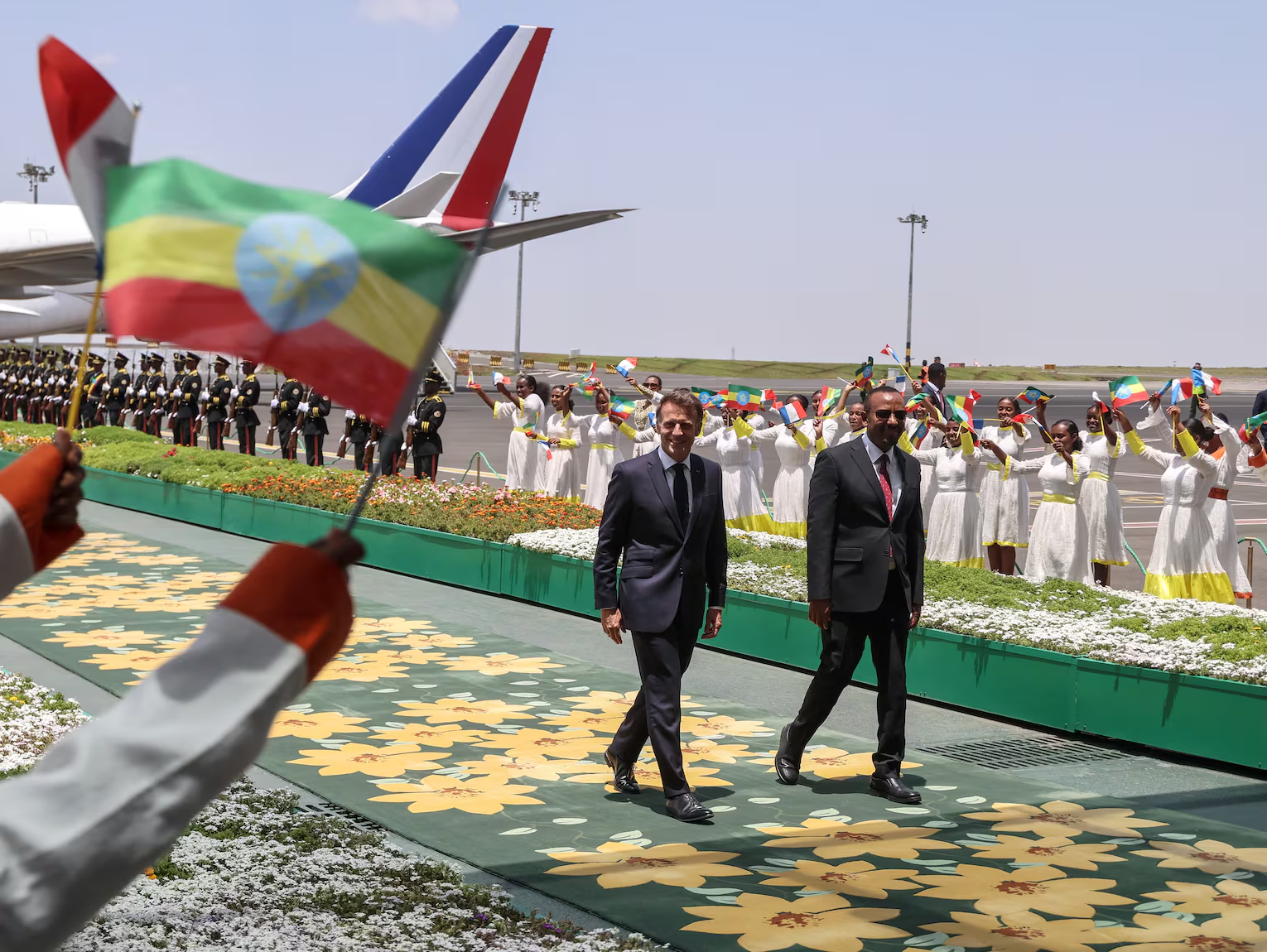
Behind the apparent closeness between Emmanuel Macron and Abiy Ahmed, France is trying to strengthen its position in Ethiopia, a key country in Africa’s changing political landscape, writes Nadia Lesdos for Le Point.
After Egypt and Kenya, Emmanuel Macron headed to Ethiopia on May 13, the final stop of his African tour. Despite a packed schedule — including meetings with United Nations Secretary-General Antonio Guterres and African Union President Mahmoud Ali Youssouf — his host, Prime Minister Abiy Ahmed, still made time to show the French president around Addis Ababa.
Macron already knows Addis Ababa well, having visited it in 2019 and 2024. But the city is changing fast because of the government’s controversial “corridor development” project. Abiy got behind the wheel himself to drive the French president to the National Palace, whose renovation was backed by €25 million in funding from the French Development Agency.
The prime minister then went off the official schedule to take the French leader to the Science Museum and then to the “Chaka Project,” a future “smart city” perched in the hills overlooking the capital, where Abiy Ahmed is building himself a large, sprawling palace. While the two leaders — both in their forties — seem to get along well, their relationship is driven above all by mutual interests.
“The France–Ethiopia relationship is strong because Ethiopia is an economic power that can easily influence the rest of Africa,” says Abeselom Samson, founder of the pan-African think tank Shengo Global and a member of the Institute for Economics and Peace based in Addis Ababa. This growing closeness, which has developed over several years, comes as France tries to reshape its approach to Africa, moving away from postcolonial dynamics toward cooperation and partnership.”
This renewed partnership with Africa was at the centre of the “Africa Forward” summit held in Nairobi on May 11–12. By hosting the event in an English-speaking country for the first time, France is acknowledging the need to broaden its networks, as anti-French sentiment grows in its former colonies in West Africa and the Sahel. As Africa’s second most populous country, an economic driver in East Africa, and host of the African Union headquarters, Ethiopia stands out as an essential partner.
The rapid modernization of the capital also offers “a huge economic market that France and Europe are trying to tap into,” notes Andrews Atta-Asamoah, adviser at the African Union with the International Institute for Democracy and Electoral Assistance. French companies are already moving in, including Carrefour, which is expected to open its first supermarket in Addis Ababa in the coming weeks.
“Countries like France have their own interests and could follow the Chinese model by investing without engaging in politics or human rights issues,” suggests Andrews Atta-Asamoah. “However, European states should also use their investments to support internal stability, which is also in their long-term interest.”
The capital is seen as an island of stability, even as tensions continue to rise in the northern Tigray region. At the same time, fighting is still affecting the Amhara and Oromia regions.
Despite this, the European Union announced on April 20 that it would resume budget support for Ethiopia, which had been suspended in 2020 after the outbreak of the Tigray war. For their part, the United States lifted an arms embargo on May 11, also imposed because of the Tigray conflict.
“These measures reflect a recognition that, despite ongoing localized conflicts, Ethiopia is gradually moving away from the prospect of a major armed conflict, as the guns have fallen silent in Tigray for more than three years,” explains Abel Abate, an Ethiopia specialist at the Chatham House think tank. He adds that the wars in Sudan, Ukraine, Gaza, and Iran have pushed the fighting in Ethiopia further down the international agenda.
“France and Europe are seeking to encourage the Ethiopian government to play a more constructive role both domestically and across the region, while also using the country as a platform to expand their own networks in Africa and the Global South,” adds Abel Abate.
But for his part, Abiy Ahmed’s welcome to his French counterpart was not without calculation. “Ethiopia believes France can help it pursue its ambition of gaining access to the Red Sea,” the researcher notes. During his previous visit, Macron described the Ethiopian prime minister’s ambition to regain access to the sea as “legitimate,” a goal Ethiopia lost after Eritrea’s independence in 1993. An ally of Djibouti — through which most of Ethiopia’s imports and exports pass — France has also been helping train the Ethiopian navy since 2019. The funding to renovate national landmarks such as the National Palace and the rock-hewn churches of Lalibela is welcomed by Abiy Ahmed, “because it helps shape the country’s image,” notes Abel Abate. Before leaving Addis Ababa, Macron also delivered his first-ever speech at the headquarters of the African Union.
“We will support the African continent in the face of the crisis in the Middle East and the closure of the Strait of Hormuz,” the president said, pledging to find solutions to the risk of fertilizer shortages, which is raising concerns about worsening food insecurity across the continent. He also announced that Paris will host an international conference in the last quarter of 2026 to raise funding for the African Union’s Peace Fund.


