A call was made for the European Union, the United Nations and the wider international community to give greater attention to the ongoing conflict in the Amhara region, the Reporter newspaper reported.
According to the paper, the call was made during a panel discussion organised by the Institute for Peace and Security Studies (IPSS) on 31 July 2026. Amanuel Tesfaye, a doctoral researcher at the University of Helsinki, said the conflict in the Amhara region had received limited international attention, as global crises—including the wars in Ukraine, the Middle East and neighbouring Sudan—had dominated the agendas of international organisations.
The discussion focused on the conflict in the Amhara region, political uncertainty, limited economic prospects, and the possibilities for peaceful dialogue. Experts called on the federal government to engage in genuine peace talks with representatives of Fano, an armed group fighting government forces in the region, with the support of third-party mediation to help resolve the ongoing conflict. They also urged the European Union, the United Nations and other international organisations to use their influence to encourage dialogue and support efforts towards a peaceful resolution, the Amharic Reporter wrote on Sunday.
Experts argued that the roots of the conflict should be viewed beyond a purely security perspective, highlighting broader political grievances, perceptions of economic discrimination, administrative bottlenecks, and limited employment opportunities as underlying factors contributing to instability in the region.
Presenting his study, “Beyond Grievance: War Economy, State Entanglement, and the Dynamics of Protracted Conflict in Ethiopia’s Amhara Region,” Yared Debebe, a researcher at the African Research Universities Alliance, said that the ongoing fighting between government forces and Fano militants has continued to create serious economic, social, and humanitarian challenges, with no clear end to the conflict in sight.
Yared stressed the need for long-term peace efforts that address the root causes of the conflict, improve people’s livelihoods, and go beyond short-term agreements. He referred to the government’s previous peace talks with the TPLF in South Africa and the Oromo Liberation Army (OLA) in Tanzania as examples.
Although efforts supported by the African Union and IGAD have resulted in agreements with armed groups operating in the Amhara region, the conflict has continued, underscoring the need for a long-term political solution that addresses its root causes.
Experts also stressed the need for greater attention to the conflict’s impact on education and development, noting that an estimated 4 million school-age children have been unable to attend school because of the crisis.
Researchers concluded that ending the conflict is essential for Ethiopia’s recovery, saying that stopping the violence could help the country return to its path as a model of economic growth in Africa.
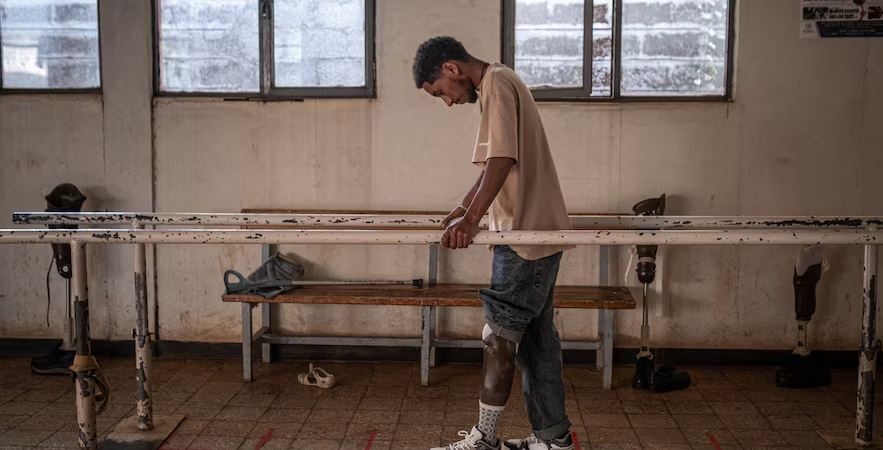
(Image: Yosef Debasu, 19, receives rehabilitation treatment in Bahir Dar on 8 December 2025 after being injured by a landmine explosion while driving his tuk-tuk in Merawi in 2024. AFP)



Pingback: Situation report: Confrontations between ENDF and TPLF in Tigray; 37 killed in drone attack in North Darfur; RSF mobilises across Darfur. - EEPA