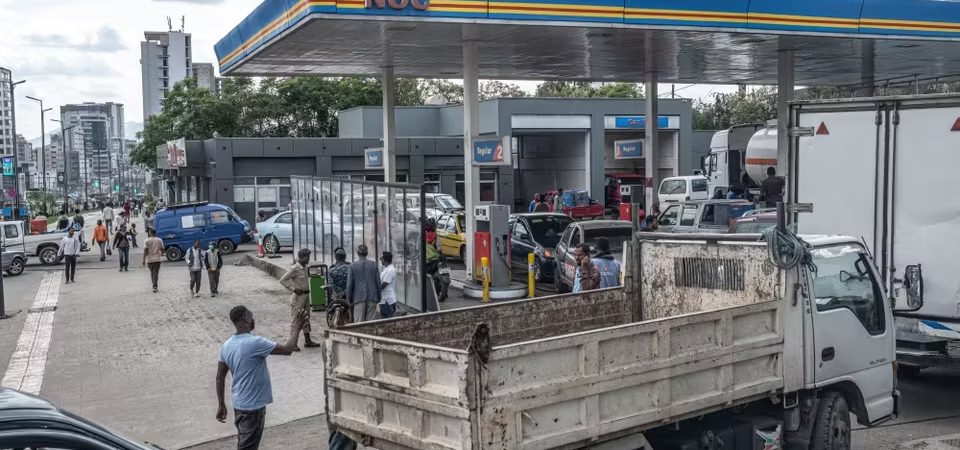
Since the outbreak of the U.S.-Israeli war on Iran and Tehran’s retaliatory attacks on its Gulf neighbors, Ethiopia—fully dependent on Gulf countries for the supply of refined petroleum—has been facing severe shortages, despite government calls for restraint, writes Maëlle Duhamel for Le Monde.
For at least two kilometers, freight trucks, minibuses, and construction vehicles are a standstill, engines off, along the roadside leading to Meskel Square in the center of Addis Ababa. Just a stone’s throw away, two fuel tankers have pulled into the small parking lot of a National Oil Ethiopia service station, the country’s leading fuel distributor. The hope for a resupply for users and, perhaps, the end of an interminable wait.
Across Addis Ababa and throughout the country, the same scenes are playing out. Tadesse, a single father who drives for ride-hailing apps, waited eight hours — from 1:30 a.m. to 9:30 a.m. — to finally fill up at a station in Megenagna, a neighborhood in the east of the capital. “I was lucky because there are fewer people in the middle of the night. A friend of mine waited a whole day and night at the same station,” he said, adjusting his small, round glasses. “But it forces me to arrange care for my two-year-old daughter, so I end up spending more money. If this continues, it will become very complicated.”
Since the outbreak of the war in the Middle East on February 28 and the closure of the Strait of Hormuz, through which one-fifth of the world’s oil passes, Ethiopia has been facing a severe fuel crisis. According to the Minister of Trade and Regional Integration, Kassahun Gofe, in a statement made on Tuesday, March 31, more than 180,000 tonnes of fuel could not be delivered in recent weeks, cutting the country’s daily diesel supply in half—from 9.2 million to 4.5 million liters. The minister also acknowledged “fuel shortages” and announced that priority would now be given to “certain vehicles, such as those transporting essential goods, tractors, and public transport vehicles.” Echoing remarks made by Ethiopian Prime Minister Abiy Ahmed on March 16, Kassahun also urged the population to “use fuel sparingly” and to “prioritize traveling on foot”. These measures have been poorly received by consumers, who are deeply concerned about rising fuel prices. On Thursday, during a speech before Parliament, the minister announced that the price of diesel had increased from 129 birr (72 euro cents) per liter in February to 163 birr (91 euro cents) on Wednesday, April 1—an increase of 26 percent.
This represents a significant increase for a taxi driver earning an average of 150 euros per month. “My company does not have the budget to purchase more expensive fuel. I doubt that we can continue to provide service to everyone,” worries Tsegaye, a minibus driver waiting in line at a station near the Bole district.
A parallel market
This dependence on Gulf oil is recent. “In the past, Ethiopia used to purchase refined petroleum from Sudan. But in recent years, and particularly since the outbreak of the Sudanese civil war in April 2023, the country has turned to the United Arab Emirates, Kuwait, and Saudi Arabia, explains Samson Berhane, an independent economist based in Addis Ababa.”
But according to the analyst, the war is not the only cause of the crisis. “It delivered the final blow to a system that was already fragile, heavily subsidized by the government, and, above all, undermined by a massive parallel market,” he explains. According to the authorities, more than 2.6 billion birr worth of fuel was sold through smuggling networks in January and February. On March 21, Kassahun Gofe revealed that a large-scale nationwide crackdown had led to the detention of 613 people and the seizure of more than 448,000 liters of “illicit fuel.”
Another case, currently being handled by the Federal High Court, involves 14 suspects, including Esmaelalem Mihretu, CEO of the Ethiopian Petroleum Supply Enterprise, the state-owned company responsible for the country’s petroleum supply. The court is tasked with investigating, in particular, the “disappearance” of 68 tanker trucks in July 2025, which allowed millions of liters of fuel to be diverted to smuggling networks instead of reaching public pumps. “With the current crisis, this kind of case is likely to repeat itself, because this stolen fuel is easier for people to access, but it is also four to five times more expensive,” explains Samson Berhane. “This risks making the population even more vulnerable.”


