
After leaving Ethiopia at the age of thirteen, a young girl arrives in Paris April 1978. The only child of an Ethiopian father and a French mother, she soon begins attending the Lycée Jules-Ferry near Place de Clichy in the north-west of the city. Standing before a classroom of unfamiliar faces, she feels overwhelmed by anxiety and acutely aware of her difference, convinced that that her classmates are judging her—especially her unfashionable coat. “Whispers, some stifled laughter. It’s her coat, they must be laughing at the ugliness of this chequered thing that compresses her. She feels ridiculous, old-fashioned, held in. If only she could take it off, go sit with the others, not be exposed to their mocking gaze (p.27).,” Myriam Tadessé wrote in her memoir, Blind Spot.
Curiously, this scene in Blind Spot is narrated in the third person, unlike the rest of the memoir, which is told in the first person—a shift that reflects the distance and vulnerability of the experience.
Through a lyrical and compelling narrative, Myriam revisits her childhood in Addis Ababa and her forced departure from Ethiopia. Born in 1965 to a French mother, Josée Roumieu, and an Ethiopian father, Mamo Tadesse, a French-educated intellectual and former minister under the imperial regime, she witnessed the upheaval that followed the rise of the Derg. Like many former officials, her father was imprisoned.
As political violence intensified, her mother struggled with fear, isolation, and uncertainty in a country that had become, as Myriam writes, “opaque and undecipherable.” Rumours, the threat of searches and arrests, financial insecurity, and concern for her daughter’s safety dominated daily life. Approaching her fourteenth birthday—the age at which she risked military conscription or imprisonment—Myriam left Ethiopia after a sudden raid convinced her mother they could no longer stay. “Five days later, we had left the country,” (p.36), she recalls.
Paris offered safety but little comfort. Living initially with her aunt, Myriam found herself disoriented by her new surroundings. The grey classrooms, barred windows, and unfamiliar faces of her school felt almost prison-like. “The teacher, she is dry and insipid, everyone looks drab, even the students, they all have the same greyish face, just like the windows looking out onto a grey that’s not even grey, a lack of colour everywhere, from floor to ceiling to the entrance gate, the street, all colourless.”(p.28)
This pervasive greyness becomes a recurring motif in Blind Spot, foreshadowing an adolescence marked by estrangement, constraint, and a gradual loss of colour.
She struggles to find her place in the new country, moving through spaces where she is positioned as both insider and outsider, never fully belonging to either category, and appearing more mature than others her age as displacement force her to confront adult realities far earlier than her peers.
This quotation captures the intensity of her experience in her own words: “So here I am, growing up like everyone else, and completely overwhelmed by a body that has suddenly become too different from the others. Too fully developed, too conspicuous for my age. Too much. A woman’s body that is a nuisance to me and attracts the gaze of men who see what I am not yet. …….I don’t know what to do with myself. Ill at ease with this label of beautiful métis that’s being thrown at me.” (p.48).
On a rare positive note, she said felt that she carried within herself the promise of an “elsewhere”—a form of richness in the eyes of “those who’d never left the confines of France.” (p.49)
Yet this perception soon shifts: she becomes “the object of predation or of envy, the richness becomes a risk, that of an exotic fantasy. Where do you come from? The curiosity of other high school students is no longer as innocent and neither are my answers.” (p.49)
Her response also becomes strategic: she deliberately begins with her French mother “to distance myself from any exotic claims.” The rhetorical question—“Could these French people who ask me so many things about Ethiopia, answer about France a fraction of the questions they are putting to me?”—reverses the direction of scrutiny. She is expected to explain about her country of origin endlessly. This imbalance is sharpened by the question: “Could they really forget to such an extent they are dealing with a person, not a tourist brochure?“
By the time Myriam recounts these experiences, she is able to reflect on them with remarkable clarity, drawing on images and memories that have long shaped her inner life. “Ethiopia takes over, takes up all the room. It is the central subject. I find myself almost having to excuse myself for being only half Ethiopian… “
“I end up saying I’m métis, because I have to say something in this country, without adding technical details, just to see. And i do see, all too quickly. I am a blind spot.” (p.50) This imposed visibility, which is at once reductive and unavoidable, eventually becomes central to the narrative, crystallised in the title of the book.
As the narration unfolds, we follow Myriam’s coming of age in Paris during the 80s 90s and early 2000s. After college, Myriam pursued her dream of becoming an actress at Rue Blanche in Paris—the former name of the École nationale supérieure des arts et techniques du théâtre (ENSATT)—while also taking courses in the Department of Ethiopian Civilizations at the Institut national des langues et civilisations orientales (INALCO). As she later reflects, “It awakens a secret wound that I was trying to heal by going to these classes. That of not speaking my father’s language.”(p.6)
There is painful boldness to Myriam’s dwelling on the a difficult past, as she remembers unresolved moments and mutual failings. When her father was released and came to France, their long separation did not lead to the expected emotional reunion. Instead, the encounter was marked by distance and disappointment, suggesting that their relationship could not easily resumed.
She explains that she had hoped her studies of Ethiopian history would be understood as a gesture of connection—an attempt to speak, across distance, in something like a shared language. As she recalls, she believed it might “please him that I’d studied the history of Ethiopia… a sign of affection and interest… an outstretched hand to start a conversation.” Her father’s response, however, was cutting: “A waste of time… You’d do better to study something more useful. Nobody talks in Amharic outside Ethiopia. It won’t you much good. What you know is more than enough.” (p.94)
Blind Spot also explores Myriam’s difficult experiences in the French theatre and film industries. She reflects on métissage and the barriers she faced in casting. In France, mixed heritage is often seen as something positive, but for her it became a professional obstacle.
Rather than recognising performers as individuals, the French film and theatre industries often expect them to fit into fixed racial categories.
The first shock came when she was twenty, in her second year of philosophy. Her agent told her that a major casting director had heard about her, seen her photographs, and—without even meeting her—had already declared her the ideal female protagonist for the next Jean-Jacques Beineix film. She met the producer, and the deal seemed all but confirmed. Yet she had still not met the director. “Time goes by. I’m worried. They reassure me, the director is thinking. Okay. I believe what I am told. I don’t yet know how read between the lines. Second or third interview with bigwig, and this time the enthusiasm dropped considerably.
Eventually, the decision came: ‘.…The director doesn’t want a métisse for the role.’ (p.15) This episode marks an early and painful lesson in the rigid logic of casting practices, where presumed opportunity can quickly collapse into exclusion.
In the ensuing years, she repeatedly heard that she was “not Black enough” for Black roles and “not White enough” for White roles, leaving her in a persistent in-between position for many years. Her experience highlights the structural limitations of a casting system that struggles to represent mixed-heritage identities, revealing how rigid categorisation can constrain rather than reflect the complexity of performers on stage and screen. This theme occupies a significant place in the short book, providing some of its most vivid passages, including the memorable assertion: “Being métisse is not a subject for me. I am the subject of this story.” (p.54).
As the narrative unfolds, we begin to piece together the deeper implications of her experience. She writes: “Métis has changed status. From an adjective, it has become a noun. It no longer describes a person; it is the person, which amounts to removing or replacing the person. The métis as such does not exist; all that exists is the product of crossbred races. An excertion of racial manufacture.” (p.54)
Blind Spot is a coming-of-age memoir shaped by displacement, alienation, and the emotional weight of mixed-race identity within constricting social norms.It offers a sensitive yet forceful essay on fraternity and the need to recognise ourselves in others a reflection of ourselves, while also calling for more nuanced representation in theatre and cinema. Its impact lies in its refusal of sentimentality or false comfort. At times, however, the intensity of its bitterness- such as in descriptions a prison-like school and perceived judgment from her classmates-creates a tension between emotional truth and objective perspective. : while the narrator’s feelings of loneliness and fear are compelling and trustworthy, the extent to which they reflect external reality is left open to question.
Blind Spot
Myriam Tadessé
Translated by Gila Walker
Seagull Books, 2021.
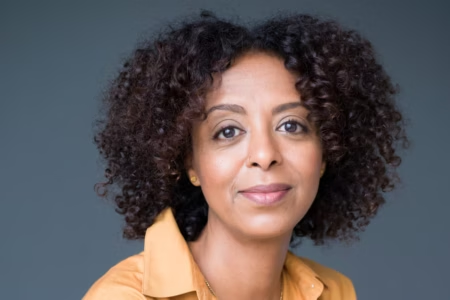


I don’t think we should take her father’s remarks, “You’d do better to study something more useful. Nobody talks in Amharic outside Ethiopia. It won’t do you much good” literally. The remark could only be from an embittered person whose life suddenly collapsed around him and who faced the terror of death but somehow managed to escape.